THE RADIO ARCHIVES ingemar@radioarkivet.se - 0736 13 14 89

New audio files received from a web visitor :  
The Kenny Everett Show on BBC Radio 2 - January 16, 1982
The Kenny Everett Show on BBC Radio 2 - January 23, 1982
The Kenny Everett Show on BBC Radio 2 - February 13, 1982
The Kenny Everett Show on BBC Radio 2 - August 8, 1982
The Kenny Everett Show on BBC Radio 2 - October 16, 1982
The Kenny Everett Halloween Party on BBC Radio 2 - October 29, 1983
Noel Edmunds' Christmas Foreverett on BBC Radio 2 - December 25, 1996, on what could have been Kenny Everett's 52nd birthday
Noel Edmunds' Foreverett series on BBC Radio 2, part 1, April 12, 1997 Part 2, April 19, 1997 Part 3, April 26, 1997 Part 4, May 3, 1997
 
 
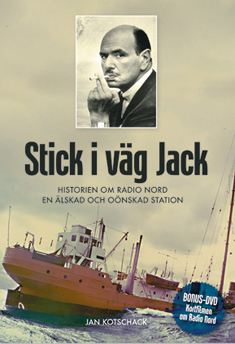
STICK IVÄG JACK
"Hit the road Jack"
The thrilling story about Radio Nord, its founder Jack Kotschack and a very different Sweden.
Richly illustrated with loads of never before published pictures.
The book comes with a unique DVD including a documentary film about Radio Nord which was shown as an opening film at the Swedish cinemas in autumn 1961.
Out now $55.00 Read more
Media Network was a programme on Radio Nederland, broadcast through the years 1981-2000. It was narrated and presented by Jonathan Marks, and he often had interesting reports about offshore radio, as for instance this from August 1985 : Radio Caroline
Sweden Calling DXers was a programme on Radio Sweden International. During the British offshore radio era, SCDXers used to give detailed reports on the developments on this radio scene. ’s an outdraw of these reports through the years 1964-70.
are slides from
Thomas Schulin's trip
to the "MV Mi Amigo"
in August 1979.
KLIF, Dallas, January 4, 1961
The Ken Lock show.
KLIF, Dallas, 1962
Russ "Weird Beard" Knight show.
KLIF, Dallas, March 3, 1962
The Murphy & Harrigan Show. Tom Murphy and "Irving Harrigan" (Ron Chapman). 8:00 - 9:00 a.m.
KLIF, Dallas 1962 jingles

WOR-FM, Barry Farber in 1963
An interview with Radio Nord's Jack Kotschack.

WMCA-New York in 1963
B. Mitchell Reed.

WABC, New York, springtime 1965
American Top 40 radio with PAMS jingles and the unrivaled legend Dan Ingram.

Three recordings with unknown dates:
WABC, New York Dan Ingram, 1967

WABC, New York Dan Ingram; 1967

WABC, New York 1968 studio quality
A linear recording (no dynamic compression) made on an Ampex 300 studio tape recorder. DJ Chuck Leonard. July 31, 1968.

scanning the dial in NYC, July 1, 1969
Starting on WABC, AM 770 kHz.
WABC, New York, April 1, 1972
Dan Ingram.
  K100 (KIQQ) in 1974
Beaver Cleaver (Ken Levine).
KFRC-AM610 Sept 28, 1978
Dr. Don Rose (Donald Rosenberg) - four times he made KFRC voted as Billboard's "Station of the Year" and he was personally named "Disc Jockey of the Year". Further reading
KFRC-AM610 May 30, 1980
Another recording of the legend Dr. Don Rose.

KFRC-AM610 STEREO May 14, 1986
A recording of AM stereo using the Motorola C-QUAM system. On the subject of AM stereo, read more

American Top 40, August 24, 1974
Casey Kasem's own production of "American Top 40". Not complete recording.

KROQ FM, March 1984 - "The Swedish Egil" (Egil Aalvik )
American Top 40, Feb 28, 1987
Casey Kasem's American Top 40 in a complete 4 hours 14 minutes recording.

In 1970, Casey Kasem introduced the radio show American Top 40 (AT40). It was a syndicated broadcast distributed to radio stations in the United States, Canada, Australia, Philippines, China, India, Great Britain, Malaysia and many other places around the globe. As the name suggests the program had a countdown playing the fourty most popular songs in the U.S. according to the Billboard's Hot 100 Singles Chart. The most important with Casey Kasem as a deejay was his anecdotes about the artists and songs that were played. Behind him he had an editorial with, in its peak, a total of 8 employees.
From its inception in 1970 the duration of the show was 3 hours. In the late 1970’s the program was prolonged up to 4 hours to reflect the longer playing time of the music of those days.
Billboard's Hot 100 was concidered the given industry standard for specifying the most popular songs for AT40 through the first years. In the second half of the seventies the hit music was so changed, resulting in an increasing specialization in formats on the radio stations. Dissatisfaction grew between the radio stations when AT40 continued to reflect the many different styles and formats on the hot 100 list. Later, this lead to the result that the Hot 100 chart was replaced by the Billboard’s Radio and Records list.


Hello all radio enthusiasts
... and welcome to The Swedish Radio Archives.
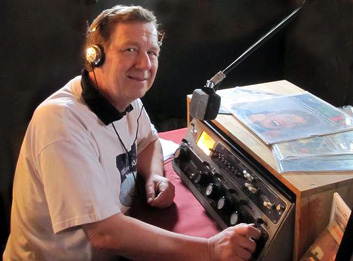
This is a non-commercial site with lots of radio recordings from my private collection, including recordings which some of the many web visitors have been kind to share with me.
If you examine this site, and not just the page you're on now, you will see that it offers a richer range of radio recordings than you find elsewhere on the Internet. In addition, most of the recordings have a much better sound quality than is usual on the net.
That's because I take into account that radio is a medium where sound has an importance for the experience - this may seem obvious to some, but is actually questioned by too many.
What makes it possible for me to give the best justice in this regard is my many years of experience in audio engineering work and I have technical equipment in best shape.

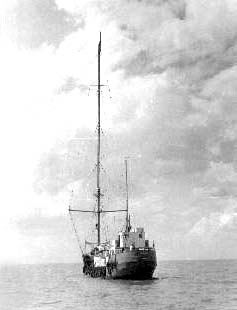
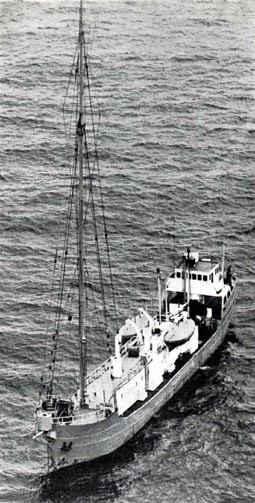
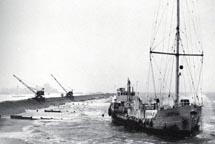
My interest in radio started when I was five, and it grew even stronger when I in my early teenage experienced Radio Nord - a Swedish free radio station that lasted for 16 months through the years 1961 and -62. On the picture on top to the right you can see Radio Nord's beautiful broadcasting ship, the MS Bon Jour, which much later, after Radio Nord's shutdown in 1962, eventually became the broadcasting ship MV Mi Amigo of Radio Caroline.

I started this website in 2006 with the ambition to offer something much better than the other radio web sites provide, and also when it comes to telling the story of this broadcasting ship. I have seen many other sites where they are trying to provide that story, but they have told it a little superficial, I think. So here is my version, and I will start way back in the start of the Radio Nord project. While you read, feel free to test my selection of offshore radio recordings in both left and right columns.


All recordings below are Kenny
Everett shows
on Capital Radio

November 1973
Kenny & Cash at 1140. Date?
November 1973
Kenny & Cash at 12. Date?
Monday, April 1, 1974
Kenny & Cash. Big L spoof. Mono.
Tuesday, October 8, 1974
KE Breakf. Show 0755-0825. Mono.
Friday, March 21, 1975
KE Breakf. Show 0745-0830. Mono.
Monday, May 1, 1975
KE Breakf. Show, 0715-0800. Mono.
Monday, May 5, 1975
KE Breakf. Show 0715-0800. Mono.
Capital Radio, June 28, 1975
KE Breakfast Show. 8 min. Stereo.
Sunday, Aug 24, 1975
KE Show, at 1415-1445. Mono.
Sunday, Oct 4, 1975
KE Show, at 1300-1330. Mono.
Sunday, Nov 23, 1975
KE Show, at 1400-1430. Mono.
Saturday, Jan 24, 1976
KE Show, at 1230-1330. Mono.
Saturday, March 19, 1977
The KE Show. Mono.
Saturday, Aug 13, 1977
KE Show 1300-1400. Special
Feature: ten years since the MOA
Saturday, Aug 13, 1977
Second part of the above,
Saturday, Nov 12, 1977
The KE Show. Mono.
Saturday, June 9, 1978
The KE Show. Stereo.
Unknown date 1978
Jonathan King chatting with KE.
Saturday, Aug 26, 1978
The KE Show. Stereo.
Saturday, Feb 17, 1979
The KE Show. Stereo.
Saturday, March 31, 1979
The KE Show. mono.
Saturday, June 16, 1979
The KE Show. Stereo
Saturday, Aug 11, 1979
The KE Show. Stereo
Saturday, June 14, 1980
The KE Show. Stereo
Saturday, June 21, 1980
The KE Show. Stereo
Saturday, Sept 27, 1980
The KE Show. Stereo.
Saturday, June 9, 1984
The KE Show. Stereo.
Saturday, March 26, 1988
The KE Show. Stereo.
Capital Gold, Dec. 25, 2004
Celebrating what could have been Kenny Everett's 60th Birthday.
Captain Kremmen. episodes from the radio version of this space comedy series
are 25 more episodes


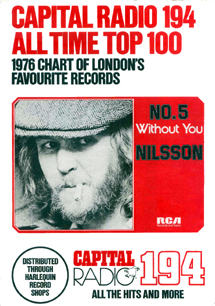
Capital Radio All Time Top 100.
Kenny Everett & Roger Scott on New Years Day 1976
at 0900-1000 countdwn 100-88
at 1000-1100
countdown 87-73
at 1100-1200
countdown 72-59
at 1200-1300
countdown 58-47
at 1300-1400
countdown 46-33
at 1400-1500
countdown 32-21
at 1500-1600
countdown 20-9
at 1600-1650
countdown 8-1


Kenny Everett on other stations than Capital Radio

R London, Jun 17, 1965
2035-2050
R London, July 7, 1965
1741-1827
A recording divided in two parts:
R London, July 29, 1966 0702-0800
R London, July 29, 1966 0800-0828
BBC Radio 2, date?, 1967 0930-1000
BBC Radio 1, June 9, 1968 1000-1200
R Lxmbg, Apr 21, 1969 29 min.
BBC Radio 1, Sept 13, 1969
121 min.
R Lxmbg, Sept 18, 1970
26 min.
R Lxmbg, Oct 9, 1970 16 min.
R Lxmbg, Oct 18, 1970 18 min.
R Lxmbg, Dec 25, 1970 24 min.
R Victory, Jan (?), 1976
43 min.

R Victory, Aug 20, 1976
51 min.
R Victory, Nov 18, 1976
50 min.
Everett's R Victory jingles
BBC Radio 2 Oct 3 1981,
his 1st on R2.
BBC Radio 2, Oct 10, 1981
2nd on R2.
BBC Radio 2, Nov 7, 1981
BBC Radio 2, Nov 14, 1981
BBC Radio 2, June 19, 1982
BBC Radio 2, sept 4, 1982
BBC Radio 2, Oct 9, 1982

"Kenny Everett at The Beeb" - a four-parts series, broadcast by the BBC Radio 4 in 1998:
Part 1 Part 2
Part 3 Part 4

BBC Radio 4, Nov 22, 2008
"Here's Kenny" - a tribute to Kenny Everett. Music journalist Mark Paytress reassesses the pioneering deejay and comedian Kenny Everett and his place in broadcasting history.
BBC Radio 2, Xmas Day 2010
A "new" Kenny Everett Show, 15 years after the death of Kenny Everett. By Paul Gambaccini.


Capital Radio, 1974
Eugene Fraser. A tribute to Cass Elliott.
Capital Radio, 1974
Roger Scott interviewing The Carpenters
Capital Radio, Feb 6, 1975

Tony Myatt, The Late Show, Capital Countdown thursday 2225-2255
Capital Radio, Feb 20, 1975
Roger Scott's Peoples Choice at 16.45
Capital Radio Oct 7, 1975
Graham Dene Breakfast Show at 7.20
Capital Radio Oct 10, 1975
Graham Dene Breakfast Show at 8.35
Capital Radio/IRN, Aug 16, 1977
The 11p.m. news "Elvis Presley is dead"
Capital Radio Nov 15, 1977
Graham Dene Breakfast Show at 8.07.
Capital Radio, Aug. 10, 1988
Richard Skinner.
Capital Gold, May 14, 2003
Tony Blackburn show at 8.30 PM.
Capital Radio jingle mania
Loads of Capital Radio (and a few other stations) jingles in a mixture made by Thomas Bergstam and me. For all us extreme jingle fans.
 

Radio Lxmbg 1963
Radio Lxmbg 208 (year?)
about Del Shannon
Radio Lxmbg, June 11, 1966
The Decca Records Show. Jack Jackson.
Radio Lxmbg, Dec 24, 1966
Jimmy Saville X-mas Show
Radio Lxmbg, October 19, 1968
Fragments of shows: Paul Burnett; Roger Day; Noel Edmunds; Tony Windsor
Radio Lxmbg 208 (year)
Tony Prince, Simon Dee and Mark Wesley sharing their memories of Radio Caroline
Radio Lxmbg, Oct 31, 1974
At 21.30: This Is How It All Began. The story behind the English service of Radio Luxembourg.
Radio Lxmbg, Oct 31, 1974
Peter Powell Show at 11.45.
Radio Lxmbg, April 18, 1976
Chris Carey Show at 7.15.
Radio Lxmbg, Aug 16, 1977
The News at 11 p.m. confirms the death of Elvis Presley and Tony Prince rapidly changes his program for the rest of the night into a 5-hour memorial program. This recording covers the first hour.
Radio Lxmbg, June 25, 1979
Rob Jones, Friday night at 9. 29 min.
Radio Lxmbg, Oct 6, 1982
Barry Aldis at 11. 3 hrs
Radio Lxmbg, Jan 8, 1989
Mike Hollis at 10. 23 min.

Radio Lxmbg, Jan 8, 1989
David Lee Stone at 02.00. 46 min.

Radio Lxmbg, Jan 8, 1989
David Lee Stone at 03.45. 22 min.

A Radio Lxmbg, Ducumentary
Noel Edmunds "The Story of Radio Luxembourg"

 
Radio Caroline recordings

Caroline North (when?)
Mike Marriott, The Late Late Show


MV Mi Amigo aground at Frinton- on-Sea after the storm, January 20, 1966

Caroline, Easter Sunday 1966
April 10, 1966, the 2:nd anniversary for Radio Caroline. Graham Webb and his even more festivity mooded mates celebrating on the 1966 Easter Sunday morning. The MV Mi Amigo had gone aground in January 1966, so this transmission was made from the former Swedish offshore radio ship Cheeta 2, owned by Radio Syd. It was used by Radio Caroline as their ship from February till May 1966. This was received and recorded in the Stockholm area.

Graham Webb - Caroline South studio

Caroline, Oct/Nov 1966
Carl Conway talks to Paul Anka followed by Dave Lee Travis, who greets Mr Anka by playing the oldie "Diana".
Caroline North, May 22, 1966
Tony Prince at 01.10 until 199 closes down. 52 minutes.
<part 1 - - <part 2
Radio Caroline recorded at nighttime in Stockholm Sweden in the summer of 1967. It's the best I've
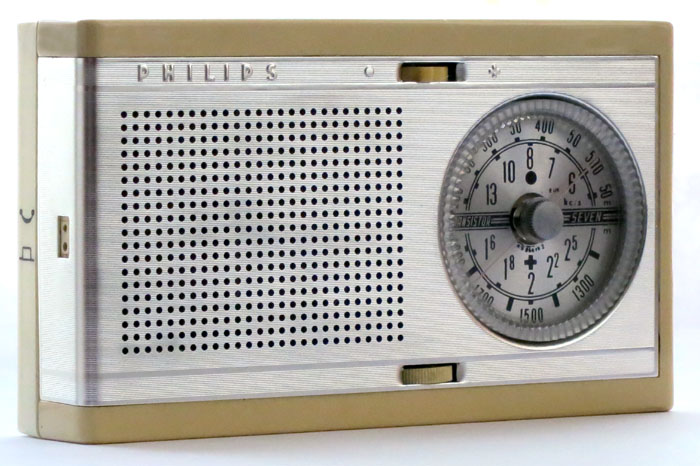
ever heard of Radio Caroline. Also I find the deejay Ian Mack fabulous. The recording was made by a friend of mine who used a regular table-top Philips radio and a Tandberg model 62 reel-to-reel tape recorder.
Radio Caroline, February 23, 1980
Stevie Gordon, recorded in Stockholm-Sweden at 00.55
Radio Caroline, March 15, 1980
Tom Hardy's, The Personal Top 30, Saturday at 20.00. "Tonight's number is 36 - also as yesterday"


On-air studio at Radio Victory in 1976
Radio Victory, June 22, 1976
Eugene Fraser and Dave Symonds.
 
TOP of the POPS at the BBC Light Channel, 1965 - Brian Matthew presenting The Hollies, Unit Four Plus Two, Donovan, Billy Fury, Wayne Fontana & The Mindbenders

Dit is Radio Mi Amigo

Radio London May 2, 1966
Mark Roman.
Radio Jackie, Aug 14, 1977
Memories from the British offshore radio era. Phil Hazleton.
The Story of Pop Radio
A six parts documentary series
produced in 1983 by Noel
Edmunds for the BBC Radio 1
1
2
3
4
5
6
Invicta Radio, August 1988
Sarah Whatsername.
Radio London date?, year?
Tony Blackburn in a recording where he's imitating the sound of the station.
Downtown Radio 20 yrs Jubilee, March 16, 1996 - the first independent local radio station in N. Ireland (Belfast).

The project was financed by Texan venture capital, and the driving force behind, setting up the station, was the American radio entrepreneur Gordon McLendon (1921-1986).
In America, he had created the Liberty Broadcasting System, which eventually became the second largest radio network in the U.S.A. It also became famous for setting new standards for sports broadcasting with daily broadcasts of Major League Baseball over 458 affiliated radio stations. In 1947, Gordon and his father acquired a license to start operating radio station KLIF 1190 in Dallas, a station which was to become the prime example of American Top 40 radio.


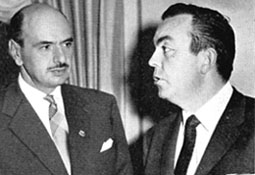
Jack S Kotschack and Gordon McLendon
 

In Sweden in those days there was a rigid broadcasting monopoly and that had been the order for thirty years. In this respect Sweden would continue through further more than 30 years to be the most obstinate of all European countries. How did Gordon get the idea to create commercial radio in Europe, and why, of all countries, did he choose Sweden? There are several possible reasons, but the first and foremost was the Swedish-Finnish businessman Jack S. Kotschack (1915-1988).

Jack had moved to neighboring Sweden in 1944 after five years as a front soldier in the Finnish Winter War of 1939-1940, and then in the "Continuation War" (1941-1944), where he also was awarded several medals for bravery. He had very active sporting interests and in his younger years in Finland, he played for the national team of bandy, and also distinguished himself as a skilled tennis player. His university studies were completed in Helsinki in 1932, and then followed three years at Herne Bay College in England where he also initiated a short but successful career in boxing, and he made it to the college championship which he also won.

Jack's involvement in sports had often helped him in making business contacts. During a business trip, Jack visited Gordon in Dallas, and they both had the intention of discussing a mutual film project. Gordon had a film studio and Jack had been in the business for several years with the company Svea Film in Stockholm.
After a while, their discussions began to move from film to radio.
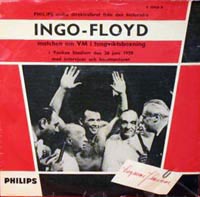
They both shared an equal interest in sports, and the main event at the time was the upcoming World Heavyweight Championship in New York, where the Swedish heavyweight champion, Ingemar Johansson, was to meet Floyd Patterson.

Several months before the game, the Swedish Broadcasting Company made it clear that they would not broadcast the match. One argument was that they felt they were unable to resist a public opinion, which saw boxing as grossly dehumanizing. It was, admittedly, a minority, but the arguments they put forward were perceived as more powerful than the sport itself. Moreover, there was another important factor: this was about pro sports! The latter was then a controversial issue, and several of Sweden's top athletes had therefore been excluded from competitions.


Radio Luxemburg
broadcasting live in Swedish
fr. Yankee Stadium, New York

 
a Philips 45 RPM disc
highlights from the match.
 

The Ingo match was considered by many as the game of the century. Another effect was that the radio monopoly became a more disputed issue than ever before - the refusal to broadcast the match caused a furious public opinion.

One person who saw a chance to jump onto the opportunity was the manager of the Swedish section of Philips Electronics, Herbert Kastengren. He bought airtime over Radio Luxembourg and it was announced that Philips would report live from the boxing match at Yankee Stadium in New York.

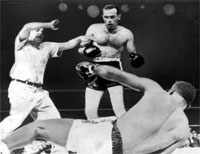
The newspapers began to provide expert advices on antenna arrangements and how to tune the radio to hear the broadcast. Then came that night, the "Ingo Night", June 27, 1959, and millions of Swedes stayed up from 11 p.m. when the broadcast began. Prior to the match the broadcast offered a great artist posse from a studio in Stockholm interspersed with interviews and telephone reports from Yankee Stadium in New York. Many still remembers what they did that magical night, and the success couldn't have been greater when Ingo at 3.37 a.m. knocked out Floyd and became the first Swedish World Heavyweight Boxing Champion.

Another source of inspiration to Jack and Gordon were the events that had taken place in the narrow space of international waters between the southern tip of Sweden and Denmark. It was Radio Mercur, which had become the world's very first commercial radio station from a ship anchored on international waters. Since August 2, 1958 they had been broadcasting from the small ship Cheeta.


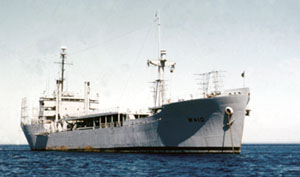
United States coast guard cutter "Courier", a 338-foot, 5,500 ton vessel, moored off Rhodes, Greece. A mobile transmitting facility for the U.S. Information Agency to broadcast the "Voice of America" programs behind the "Iron Curtain" during "The Cold War" years.


The founder of Radio Mercur was Peer Jansen (1930 - 1968) who had gotten the idea after hearing the Voice of America broadcasts from a ship on the Mediterranean Sea. They were broadcasting western news and culture aimed at listeners in the Eastern Bloc. Peer came to realize that they were using frequencies which had not been authorized by the International Telecommunications Union. This, however, didn't seem to bother no-one at all - except presumably those in charge in the Soviet Union.

Like most teenagers in the late fifties, Peer used to listen to Radio Luxembourg. Through a misunderstanding, he had been led to believe that they too, were broadcasting from a ship, anchored in the English Channel. This he saw as an additional argument for the idea: if Radio Luxembourg can broadcast this way - then can we! As we all know, Radio Luxembourg had fully legal transmitters on dry land and on legal frequencies. However, the intentions were obvious:
Through the use of broadcasting facilities installed in another country, and by using transmitters with excessive power, their aim was to circumvent the current British broadcasting legislation. It was a business in a gray area - not quite pirate radio, still a form of, and was viewed badly by the authorities in the targeted country.

A cousin of Peer, Børge Agerskov, was doing his university studies in law. He was caught by Peers ideas and took the time to study the Danish legislation on broadcasting. He found that it had completely overlooked the possibility to broadcast from a ship out at sea to a specific country, and thereby circumventing the monopoly on broadcasts from within that country. This order was equal in most countries, and Børges discoveries would later serve as an inspiration to many other offshore pirates. But it was Peer Jansen and Børge Agerskov who first of all saw the whole context.

There's no doubt that Jack and Gordon felt that the recent events surrounding Radio Mercur were inspirational and offered them great encouragement. After a lot of intense talks, Jack said, probably only as a joke or as a reckless idea, Let's make a radio station! Gordon was not lingering on the answer, he only said: OK, Go ahead, Jack.

The Neptunbolaget's ship "Herakles"

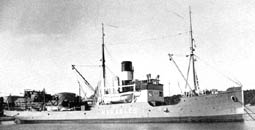
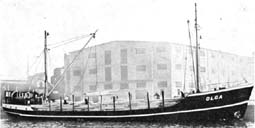
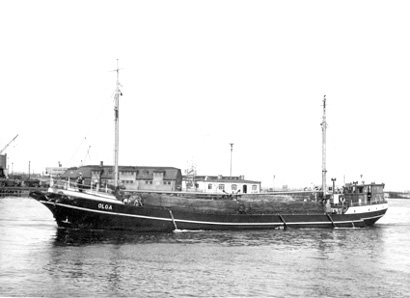
The original "Olga" before she was converted

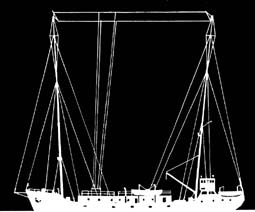
A graphic image showing the design of the
Bon Jour as a two-masted broadcast ship

Bon Jour at Langeline, Copenhagen
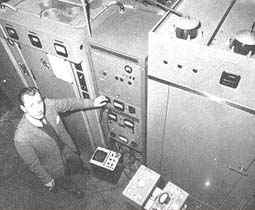
Engineer Roland Englund behind the transmitter
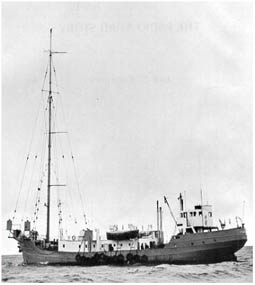
The Bon Jour, prepared for broadcasting

So far, nothing
at all on 495 m.

It seemed quite simple to "go ahead", but it would prove to be an uphill struggle in which many storms blew up, both in terms of weather conditions and in harassments by government officials, or the telecommunications authority and other powerful representatives of the establishment. Such extreme actions as jammers and hijacking the ship on the high seas were actually considered.

A much more unexpected hindrance appeared when the central organization of the advertising agencies advised their members to be cautious and to avoid radio advertising. How much damage could it do to the public's trust in a brand name if it became associated with a radio station that was perceived as "bad", and what if the venture should end in a fiasco? The newspapers and journalists mainly drew up shady, negative scenarios of the new radio station because they were worried that radio advertising would mean harmful competition to the ability of newspapers to attract advertisers.

When Jack, at the beginning of 1960, began the search for an appropriate ship, he initially became interested in a salvage ship, Heracles, owned by the Neptune Company. Jack asked the magistrate inspector to conduct a thorough inspection which resulted in a positive report. Jack felt that the vessel issue thereby had been solved in a reliable way. However, Gordon's confidant, Jim Foster had been involved as “marine experts” and wanted to exercise his greater authority in the matter. He considered Heracles inappropriate - too small! Instead he advocated (the only half as large) Olga, which he had found, moored in Kiel Canal in Germany.

Bob, Gordon, Jim and Jack flew down to Hamburg and then onwards to Kiel, to inspect Jim's findings. Perhaps they had gained too high expectations, in all cases it appears to have been so for Jack. In his book, he described his first sight of Olga like this: "I think she was one of the ugliest boats I have ever seen. Small and worn she lay on the dock, scattering an intense smell of rancid herring, noticeable in a well 20 meters away". It could have been that Jack felt a bitter touch of the didactic he might have experienced from the "marine expert" Jim. However, on the long run, Jim would prove to be quite right - she really was a great ship!

Olga was a 2-masted steel schooner of 250 gross tons, built in 1921. In its original outfit she was 30 meters long and named SS Margarethe. She was one of three sister ships - one came in use as a tug in South America and another was sold to a company in the Far East. SS Margarethe was used for cargo traffic on endless trades over the Baltic and the North Sea. Through the years she underwent several extensions of her hull. The last was conducted in 1951, when she had her final length of 41 meters including the bowsprit of three meters. From the beginning she had been a steamer but her engine was being replaced twice, the last was in 1936, when the Deutz 150bhp diesel engine was installed and became her source of propulsion for the rest of her years. After the change of ownership in 1927, she was renamed Olga after the new owner's wife. In June 1941 she was requisitioned by the German Kriegsmarine in Emden, but apparently she must have been very poorly rated there; in November 1943 she was taken out of the Nazi marine rolls and was returned to her civilian owner.

On May 31, 1960 she was towed to Norderwerft, an alteration and repair shipyard in Hamburg, where she underwent a major renovation. The cargo hold was converted into crew cabins, storerooms, rooms for transmitters and space for the two heavy 60 Hz Allis Chalmers-generators, each of 93 kVA (=75kW) to power the transmitters and studio equipment. Directly below the mast was installed the two Continental Electronics 316b transmitters of either 10kW. Above what had been her hold was built the characteristic superstructure with the galley, mess and the studio techniques. She also got her name Bon Jour carved in the bow, and the hull painted in its new orange color.

On August 10, the shipyard received a message from Hamburg Oberpostdirektion where they recalled an old Hitler Law of 1937 which made it illegal to install, repair or perform any work at a radio station without permission from the government. Inspections were made by a posse of authority representatives - some of them were Swedes. This made it urgent to hastily move the MS Bon Jour to the Copenhagen free port Langeline for the proceeding work. The 38 meter high mast was erected on the foredeck with rigging and guy lines. They had initially ordered two identical masts and the idea had been that the antenna would be a "flat top" design between the two masts. However, Gordon had connections to an antenna expert, John Mullaney, from the American Navy. His unique antenna principle, called the folded unipole, an inverted ground plane antenna, solved the problem with the mast which actually was very far from any ideal length to function as a half wave aerial. The unique feature was that John Mullaney's antenna design took advantage of the forward and aft guy wires from the mast's top to contribute as radiation elements in addition to the mast of steel. To make this possible, it was necessary that the wires from the top were connected through carefully tweaked vacuum capacitors to ground (the hull). These special capacitors, built in metal boxes, are visible on the deck on some photos of the Bon Jour.

The most time-consuming work in Copenhagen was the installation of the transmitters. They had been delivered as a kit of 6000 parts and was put together, component by component, by Glenn Callison, chief engineer from KLIF and his assistant Archie Mesch.

On Tuesday, December 20th, 1960, it seemed as if all preparations on Bon Jour was completed and at 6 PM they were set to leave Langeline and begin the voyage up the Baltic Sea. Still remaining on the quay was the second mast which had proved to be unnecessary. At 8:30, they had to anchor because of heavy fog. At 5 on the Wednesday morning, the journey continued.
An article in Sweden's largest daily paper, Expressen, on Thursday, December 22, confirmed that Bon Jour had departed from Copenhagen two days earlier:
-The boat left Copenhagen on Tuesday for its 48-hour trip to Stockholm, says consul Jack Kotschack. That means, if nothing unforeseen happens, that the boat should be on its anchorage already tonight. And then, it's just to start the broadcast.

However, it would take much longer than the estimated 48 hours because of the weather at the time. It was stiff breeze, 10 - 12 m/sec and very rough seas. Bon Jour had in this harsh weather, with her round-bottomed design combined with her high mast, a seaworthiness that got her into a terrible swinging from stem to stern. It was noticed that the stay lines on the mast were working loose. They dropped anchor to repair and adjust the rigging. Most of the men on board were unfamiliar with sea conditions and must have been at worst discomfort. In the case of a disaster there had been no ability to make distress calls; there were no radio telephone on board yet. If Bon Jour was wrecked their only chance was the lifeboat, which was equipped only with oars, no engine.

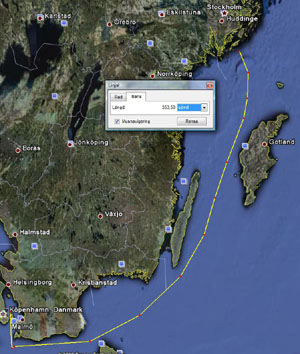
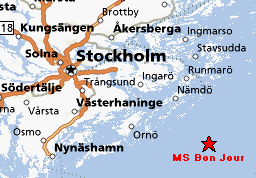
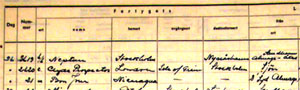
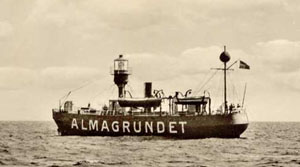
When Bon Jour, after an arduous voyage, on Friday at 11 am, at last arrived the Stockholm archipelago, the captain choose to drop anchor at a safer spot than the estimated near island Ornö. Instead it was at Almagrundet, where a lightship was nearby with constant monitoring. If an emergency should arise, it was thought that the lightship would call for assistance through their radio telephone to the nearest pilot station. From the archives, it has been verified that the guard on Almagrundet noted Bon Jours arrival south of the lightship.

At last the moment had come when the radio technicians on board could start practical tests with the transmitter at full power. Previously, their only options consisted of testing through a so-called dummy load, not the real antenna mast, as that would have been a violation of the radio laws. But now, with Bon Jour on international waters, the moment finally arrived!
However, Glenn Callison's promises of the transmitters full functionality became completely contradicted when a blue flash striked out between the mast and the rigging, and the transmitter immediately went dead and silent. Archie, Jan and Ove understood that they now had to deal with difficulties trying to find out what had gone wrong.

The fishing boat "Dunette" had been booked in advance to search for Bon Jour on Friday - the day before Christmas Eve (in Sweden, the 24th is the important feast day of Christmas, not the 25th as in some other countries). The idea was that the "Dunette" would deliver fresh newspapers, and the newly recorded christmas premier programs - and Jim Foster, who we remember as Gordon's naval expert. When Dunette arrived at her estimated spot - Ornö / Dalarö Skans - her captain reported (Dunette had a radio telephone) "The Bon Jour is not in sight here". There was nothing to see except the open desolate sea - and that's the way it use to be outside Ornö. When Jack received his message, it came as a lightning strike in the atmosphere that prevailed; in the absence of the test broadcasts which s h o u l d have been started already, somewhere near 495 meters medium wave.

Before Christmas Jack had pre-ordered delivery of 2000 telegrams to Sweden's most important business and official persons:
"Do you know that Radio Nord is now on the air? Turn on your radio now and you'll hear the modern radio station!"

Dunette continued searching for Bon Jour on Christmas Eve. But then the captain of Bon Jour had chosen the better safe than sorry solution to abandon her in his fear that the mast was going to collapse. A salvage tug had picked them up and brought them safely to Sandhamn.. It was true that it really had been in bad weather, and this was later to become even worse, up to 17 m / sec.

The captain Elis Olsson got the sack, and some have later chosen to describe him as a lousy captain. As further evidence of his poor seamanship, they have claimed that he was the first to abandon ship. - and even more, it was near that one in the crew was left forgotten on board.
Or was this whole story untrue - the mistakes that he was accused of would later prove to have its debt to the poor work done by the shipyard in Copenhagen, and that he had actually done what was possible to rescue the situation. The Swedish newspaper Dagens Nyheter (Daily News) on December 29, said that the captain had expressed concerns in Copenhagen about how the work had been carried out in the yard and he had requested that the shipyard would perform an inclining experiment, but the yard said this was excessive.

The captain would soon prove to be completely right, but then he had already been sacked. There remained a lot of work connected with the stability of the mast's rigging. But there was further reasons to the debacle that had arisen: the transmitter that did not work, the overly optimistic expectations of a rapid premiere for Christmas. But most of the drama was because no radio telephone had been installed. None of these problems had nothing to do with the competence of the captain.

Nevertheless, a new captain was hired, and he would become very popular with everyone on board. His first assignment was to take the Bon Jour to Åbo, Finland, where she at the shipyard Chrichton-Vulcan for repairs, and mainly to get the problems concerned with her mast rigging solved.

On February 4, 1961, the Bon Jour left the ship yard, heading to her position near island Ornö, only to find that a gale began to blow up and the shp had to set off again to try to find a calmer position. While this happened, a crack was heard, folloved by a "rain" falling of small white pieces of what had been the porcelain insulators from the mast guy lines. Once again she had to limp off to make repairs, this time they choose to go to Finnboda ship yard

On photographs where you see Bon Jour straight from one of the sides you can see that the balance of the ship makes her mast tilt slightly backwards. This is caused by the fact that she was originally equipped and planned as a schooner; with two masts. Without the aft mast but with a very heavy and large mast in the bow, she tended to be a quite rocking front to back. On some pictures you can also see that a large part of the rudder remained above the water, meaning that the rudder wasn't so effective. In rough wheather conditions, Bon Jour could be difficult to control because the lines connected to the steering wheel was directly linked to the rudder - she had no power steering.

Below the bridge, which was quite far aft, were the berths for the captain, mate and chief engineer. Farther aft, lowest down, was the engine-room and the newly installed diesel generators to power the transmitters and studio equipment. These generators were electrically separated from the vessel's conventional generator for lighting, etc.

Up in the superstructure, or deck house, in its most aft end, was the galley next door to the pantry. In the next room - a small room, was a ladder down to the cabins for the rest of the crew on board. Continuing forward in the deckhouse was the washing and toilet facilities and a shower. Further forward there was a combined dining and recreational space on board. There were floor-fixed tables, comfortable armchairs and also a TV with good reception of Sweden's, then, only TV channel. At the forward rooms was the studio and a control room.

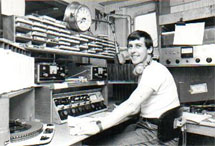
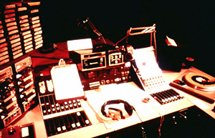
In the control room, the most dominant sight were the four large tape recorders of the American brand Exacton. Originally they had been planned to offer an ability to make programmed automatic broadcasts at night where each of the tape machines would hold prerecorded music, each song combined with an announcement and separated with green "leader" tape. A separate smaller tape recorder was for the commercials and for other prerecorded material. An automatic random switching between these four tape reels would completely avoid any repetitions of the same song combinations. The automatic switching between the tape machines was triggered by the silence occuring when a song was finished and the following leader tape was passing through, then immediately it would start the next tape machine. The tape reels would be shifted before each night. It was, for its time, a "modern" idea, but eventually the whole idea was abandoned since it had failed too often. In its most succesful events it had anyhow led to too lengthy silences between the programme ingredients. The prerecorded tapes were used at times, but then only manually. Later they changed this entire tape-rack-stand with two Ampex recorders of the same reliable model, 350b, that were used at the studios in Stockholm.

The company had employed educated professional journalists as early as October 1960. By a coincidence it happened that the day when they launched newscasts they also had something very particular to report: Russian Jurij Gagarin became the first man in space that day, April 12, 1961. The editors main working tools were the two communication receivers, one National NC-400 and one Hallicrafter SX-100 and also through a Creed RTTY teleprinter machine to receive telegrams from newsagencys such as Reuters AFP, AP, UP and UPA. The news readers listened primarily to the BBC World Service and Voice of America. They also had frequent radio telephone calls to the Stockholm headquarters to receive home news. Radio Nord was the first media in Sweden to report about the "Bay of Pigs" invasion, where a CIA-trained force of Cuban exiles made an unsuccessful attempt to overthrow the Cuban government of Fidel Castro. Another dramatic event when Radio Nord was first with the news was on September 17, 1961, when the United Nations' secretary-general Dag Hammarskiöld - a Swede - died after a plane crash between Leopoldville and Northern Rhodesia. It was a tragedy that paralyzed Sweden and the world, and it has never been clarified whether it was a political sabotage or an accident. The news was first received by the chief engineer Ove Sjöström via short wave. The news reader Lars Branje, who previously had many years of experience as a pilot of the Swedish Air Force, made a knowledgeable narrative of the dramatic event. The vast knowledge that was offered in this particular news coverage must have been difficult to other Swedish news media to beat.


Many have tried to portray Jack as politically naive. They use to say that Radio Nord had never been launched if a more sensible analysis of the political prospects of the project had been made. I see it differently. Jack had the ambition that Radio Nord would become a hit among the radio listeners - and with this he managed with a great margin. His idea was that such a large audience would also create a strong public pressure that politicians would not dare to oppose. I think that an analysis in the planning stage had never been able to predict the exorbitant priority that the government would give to an intellectually so harmless radio station as Radio Nord was. In his book "Radio Nord will return" (1963 in Swedish), Jack writes in his foreword: When they wrote about me personally in the press, they often used the word naive. I admit that I didn’t quite understand what they meant - as a comparatively successful businessman, I considered myself to be a realist. And a realist, I am still to this day, but at one point, I give the papers right in saying that I was incredibly naive - when it comes to politics in general and politicians in particular: I had the naive belief that MPs were elected to effectuate the people's wishes - not oppose them.

Jack continued the preparations, and to the press he stated a date when the new radio station would be launched. Unfortunately it was passed, and there were several such dates passed.

Anyhow, to make a very long story a little less long, it was at the beginning of March, 1961, when test transmissions were heard on medium wave 495 meters:
test transmission Friday March 3, 1961 Live from MS Bon Jour
The anonymous radio voice was counting "one - two - three - five, five". Why did the voice drop out "four - and why did it repeat "five"? Strange...
test transmission Tuesday March 7, 1961 Live from MS Bon Jour
They also announced instructions addressed to what was called the contest participants. Everyone listening to 495 wanted to candidate for that contest, but how? Of course, the intention was to make the impression that something exciting was going on, and to catch as many listeners as possible.


Test Transmission under the leadership of Archie Mesch, measuring and listening. Also chief engineer Thure Andersson and at the stern a German crewman, Knies.
Studio engineers at the premises in Stockholm, Bengt Törnkrantz and Lars Klettner

A minor frequency adjustment was necessary to avoid an interference, audible as a constant tone of 4 kHz caused by the intermediate frequency of the strong transmitter at 602 kHz in Lyon, France. A couple of days after this was discovered, Radio Nord made a small shift of the frequency, by a change of crystal, so that it became the same as Lyon, and the disturbing tone disappeared. This frequency change also meant that the wavelength was different from what they had planned. Instead of 495 meters it became 498.2, but in the programs they continued to announce "495".

A few days later it finally happened - the big premiere, starting at at 10 am on March 8th:
Premier, Wednesday March 8, 1961 The 12 first minutes of this recording also reflects that they played non-stop music prior to the hour. Then they played the first Radio Nord jingle. It was on the tune "Bye bye Blackbird" in which we also hear a voice-over by Radio Nord's own jingle wizard Henry Fox. Announced by Gert Landin followed an introduction speech by Jack Kotschack. With his Finnish-Swedish dialect he started:
-Dear listeners, Radio Nord is a reality. After more than two years of preparations, after many overcome obstacles, I have the pleasure to introduce this new, contemporary radio station.
Radio Nord is a radio in tune with the times; it should be there when you want to hear it. We at Radio Nord never sleeps, we bring our programs to you, 24 hours a day. Radio Nord has been designed to offer pleasant entertainment, current news, exciting competitions and interesting information; we have done our best to create a program to suit YOU - our listeners. But we know that neither Rome nor Radio Nord was built in a day. We greatly appreciate your interest and opinion. We make our programs to you. Therefore, let us know what you think about them. Cooperation with our audience gives us guidance for the future. Please write to us, to Radio Nord (address).
[...]

Jack's speech was followed by a song for the day, The Radio Nord waltz, composed and performed by Sweden's then, and still today, most beloved poet and troubadour, Evert Taube (search Google). It was an honor to the company Radio Nord that he appeared with his dedicated composition, almost like a hymn or a poem, to the new radio station.

The station's first commercial was for the then completely unknown brand for dishwashers, Westinghouse, which eventually became Sweden's most famous, but nowadays it's completely forgotten. The program was filled with music in many diverse genres, Swedish pop, Frank Sinatra, Swedish accordion music, Ray Conniff, Elvis Presley, Swedish light music, and so on.

The response after the premiere showed that many had been surprised by the station's programming style. The audience and the newspapers had expected that Radio Nord would sound quite similar to what they had heard from Radio Luxembourg. Most music stations in those days used to have hours and half hours allocated to different musical preferences, rock music, old time, South American, etc. At this point Jack made something completely different in European radio. True, he had carefully studied Gordon's famous Policy Books on how to achieve success, but Jack had his very own views on how to format his station. His thesis was that no new entrant listener would get the time to be bored and shut off their radios because the entertainment he or she prefers was not heard soon enough in the program. Any listener would be able to go in and out of the program at any time - no programming times to keep track of and there should never be a programming content that referred to something that had occurred previously in the program.

Jack's idea was that each group of listeners really is a minority. The group that prefers to hear rock music is small compared with those who want to hear anything else. The same can be said about all other groups of listeners. It is always harder to make a listener to turn the radio on than to turn it off. If a listener has shut down the radio because of dissatisfaction with what was offered just then, it is much harder to re-gain that listener. It was important that no listeners would get to be unhappy with Radio Nord. The music should always, within a reasonable time, appeal to each listener.

Radio Nord had offices and studios in central Stockholm and became very popular with their mix of popular music, deejays and news 24 hours a day. In the earlier stages, the announcers often appeared as pre-recorded, rather stiff voice features. Soon enough they developed a more easygoing style on how the program was announced. I think Larsan Sorenson helped to ease up the sound of the station and how the announcers appeared. He had worked many years as a cabaret artist and as an early stand-up comedian, and he was a great inspiration source to the other announcers on the station.

At the autumn of 1961, after 8 months on the air, they introduced a growing number of live broadcasts from the MS Bon Jour. Radio Nord was the first offshore pirate to discover that it was possible to broadcast live out at sea from the ship - to actually use turntables. Before they examined it, everybody assumed that turntables could not be used in such a rocking environment, that the tone arm would helplessly lose track over and over again. What they discovered was that the rocking, even in fairly rough weather, was not that hard and jerky, and the tone arm remained on track mostly without any problems at all.

Radio Nord's most popular program was the Top 20 where they played the 20 most popular discs each week. In the first months it was hosted by Gert Landin, later by Larsan Sorenson. The listeners voted through letters sent to Radio Nord where they could choose up to three songs, later a maximum of five. No record store wanted to be without the important top 20 posters which also offered good publicity to the discs that were hot each week. Between about each other song, the host took some time to talk about the current week's sponsor of that program. Sometimes they also had a popular artist in the studio who was interviewed in the show.

From November 12 1961 they introduced De Tio, a Top 10 of popular songs in Swedish. The program had been suggested by two record dealers who had noticed the importance of the Top 20 list and asked if it could be supplemented by a list of Swedish recordings. The program came as a welcome change to the program menu on Sunday mornings where they, before, had been a little too afraid of being perceived as vulgar if they played popular music in the middle of the Sunday worship time. In order to not offend any opinion they had chosen to play a light and melodic selection of classical music, which really wasn't the right niche for Radio Nord. After they broke this caution and introduced this rather innocent chart program, it became a great success. A success that still remains after all those years, because Radio Sweden immediately competed with a full-alike program that still remain in their programming today.

Despite politics and religious issues being banned at the station, it was forced to close down when the Swedish government introduced the "Lex Radio Nord" of 1962, criminalizing the act of buying advertising time on the station. The adventure ended when Radio North closed at midnight June 30, 1962. The Swedish offshore radio legislation became a model for the British Marine Broadcasting Offences act of 1967 and to other European countries where their governments wanted to retain monopoly radio.
The Swedish radio monopoly remained unchanged during the many years until 1993 when the Swedish parliament finally approved the establishment of independent local radio stations. This occurred only after the former Soviet republics - and even Albania - had already done so. After all those years, Radio Nord still plays an important part in the Swedish radio history.

Radio Nord's Bon Jour passes past the stern of Radio Syd's ship Cheeta 2, where someone was attentive with the camera. The two ships never came closer than this and there was no reason to exchange collegial greetings between the two pirates either - there were no radio staff on board. Just passing...
An image from October 1962. Mi Amigo has anchored near Veronica's Borkum Riff off the Dutch coast.
Caroline and her father John F. in 1962

Smile please! Ronan O'Rahilly / Allan Crawford
 

The Swedish "Lex Radio Nord" came into effect on August 1, 1962, but the company still chose to shut down a month earlier, at midnight, June 30 / July 1. In an interview I did in 1981 with Jack Kotschack he told me about this episode of Radio Nord's last days:
"In the last days of Radio Nord I was visited by a ship owner's son who was named Ronan O'Rahilly, together with a Swede. Their business was that they wanted to buy the boat, eh,, their appearance and behavioral impression on me was that it was empty talk, so,,, I,,, didn't bother to take their offer seriously."
Perhaps Ronan (then 22 years) failed to give an appropriate impact. However, Jack had already received a proposal from a different company, and that was the actual reason why they closed down a month "too soon". At the time it seemed as if they were in the final stages of the negotiations with an Australian businessman, Alan Crawford and his consortium Project Atlanta Ltd. with Alan's associates Kitty Black and Oliver Smedley. Alan was a former president of the dominant American music publisher Southern Music. He had formed his own company, Merit Music, and with the Atlanta project, he would start a radio station on international waters outside the Thames estuary. The station was expected to reach an audience of millions of radio listeners in the London area. Alan's intention was to use his radio station to promote his record label operations, and Radio Nord's vacant broadcasting ship offered him the total solution for a rapid implementation of his idea.

On July 4, 1962, four days after Radio Nord's closing, she left her former anchorage, with new-recruit Polish staff on board to take her out of the Baltic Sea. On Radio Nord her name had always been mentioned as Bon Jour, but since about seven months, her name had been re-registered "Magda Maria". All the studio equipment was loaded on board, including all the equipment used at the studios in Stockholm. She was also loaded with the entire grammophone archive, both the minor which had been on board and the much larger from the premises in Stockholm. All of the commercial value of the company were now gathered in the ship and its cargo. The owners felt concern that any further intervention from any authority would occur during the trip, not least on her passage through the narrow strait between Denmark and Sweden. But this time the ship had an easy trip all the way to the North Sea.

The owners were still Bob Thompson and Clint Murchison. Behind them was Gordon McLendon, who preferred a less official position, but he was in fact the foremost in the negotiations, and it was he who had invented the name of the new project; Radio Atlanta, as a tribute to the city in Texas where he grew up. A few years later he would also be involved in another business partnership with a certain Don Pierson (1925-1996). With him, he drew up the guidelines for a mirror image of the one of his radio stations that he was most proud of, the KLIF. In the Thames estuary it was agreed to be called KLIF-London. However, at the premiere on December 16, 1964 - and thereafter - it became known as Wonderful Radio London. But that's a different story.

During the negotiations between the owners and Alan Crawford, Magda Maria on August 2, 1962 arrived at the port of El Ferrol in northwestern Spain, where she would undergo some restoration work. On September 14, 1962, it seemed that the negotiations had ended successfully and that the transaction was made, and old Bon Jour, now renamed "MV Mi Amigo", sailed from El Ferrol bound for Dover in England.

However, the negotiations were not completed at all, and yet in January 1963, the future of the Atlanta Company remained uncertain. Mi Amigo's hull was repainted in a green color, and as a modern Flying Dutchman she sailed on the North Sea. She had a crew of a total of 8, the captain and the crew were Poles, but they knew nothing about what would happen next. As a gloomy memory of the days of Radio Nord, she was filled with her precious cargo, wrapped in plastic. She was usually anchored at sea off the Dutch coast, near her fellow pirate ship, Borkum Riff, used by Radio Veronica - which also was doomed to uncertainty until the Dutch authorities would take decision on her fate. An incident that had darkened the prospects for Radio Veronica, and even more for the Atlanta Project, was the heavy-handed police intervention, which had been made against Radio Mercur :

Radio Mercur had illegally resumed transmissions two weeks after the Danish 'Pirate Radio Law" had come into force on August 1, 1962. After three days of broadcasts, the ship was boarded by the Danish police, which then towed the vessel to the port of Tuborg, where she was seized and the transmitting equipment was smashed to pieces to ensure that it would never be used again. The measure was so disturbing to Crawford's financiers that they eventually withdrew their interest in the deal. In his desperation, Crawford tried to propose the owners that he would lease the vessel, but they turned his offer down. The future of offshore broadcasting seemed very darkened, not only to Alan Crawford and his investors who had abandoned him, but also to the Americans.

On January 26, 1963, the latter company took the Mi Amigo to cross the Atlantic, to Galveston, Texas, where she arrived on March 9, 1963. Their immediate plan was to release her from her unfruitful broadcasting adventures and convert her into a luxury yacht. The continuation of this story tells us that the mast was demolished and all the radio equipment was mounted out of her. Nevertheless, some nine months later, Crawford finally managed to raise sufficient capital, and the deal was completed, at last, on December 18, 1963. The ship was now officially owned by Rosebud Shipping of Panama (Radio Atlanta). Ten days after the deal was finished, the Mi Amigo departed Galveston, and after a lot of drama, she on January 30th, 1964 arrived at the shipyard of El Ferrol, Spain, again, where work would be carried out to improve her stability to carry a higher mast construction than before. On March 3, she was bound for the shipyard of Greenore, Ireland, were she would be fitted with the new mast with the height of 43 meters - five meters higher than the one used for Radio Nord. The shipyard was, by the way, owned by Ronan O'Rahilly's father.

Ronan (1940) was trying to promote the R&B and mainstream-jazz singer Georgie Fame. Ronan discovered that the record industry was dominated by "the big four" - the EMI, Decca, Pye and Philips labels. They also had dominance on the BBC, which completely ignored all the smaller labels, as Ronan's. He tried on Radio Luxembourg, but found that their programs were usually sponsored by the same four labels, who thus "owned" the program. Ronan felt that the only way to get his artists played on the radio was to start his own radio station. In Ronan's reflections on his station, he soon started to call it Radio Caroline. He had been caught by a photograph in a newspaper where the U.S. president John F. Kennedy 's daughter Caroline had a magical look that made her seem just so young, free and fresh like Ronan imagined in his thoughts for the station he wanted to create. A dreamer, he was perhaps, but still a lot smarter than Alan. Ronan had been aware from the outset how to organize an initiative of this kind. Alan had not understood anything of what had happened in the past. In interviews, he said that he needed 12 lawyers before anyone found out how one would do (ie, the usual procedure to circumvent the law - the same as already had been used by other pirates: flag from a country that was not a member of the International Telecommunication Union, a holding company in Luxembourg or Liechtenstein, and so on).

Ronan had offered Alan to use his fathers ship yard at Greenore in Ireland in exchange for Ronan's company to use Crawford's recording studio for Radio Caroline. Thus, there were two different companies and two vessels anchored close to each other at Greenore, both in fierce competition to become the first to reach the important broadcast premiere. Ronan's ship was a former Danish passenger ferry, "Fredericia", which now was renamed the "MV Caroline". Both Crawford and O'Rahilly have later admitted that they were doing numerous acts of mutual sabotage to delay the other company's launch. Radio Atlanta's Mi Amigo became the first to leave Greenore and the journey bount for the Thames estuary. However, of unknown reasons, it took almost a full month before they reached past Lands End . On April 21, the mast broke when the M.V. Mi Amigo was caught in a gale and needed further repairs to be carried out by riggers from Portsmouth and because of this delay, Radio Caroline went on air first, starting midday on Easter Sunday, March 28, 1964. The ship MV Caroline was anchored at a position five miles off Harwich, broadcasting on 1520 kHz. After the "Caroline bell" the voice of Simon Dee introduced the station by saying "Hello everybody, this is Radio Caroline broadcasting on 199, your all day music station". In the beginning, Radio Caroline limited their broadcasting hours to twelve hours a day, ending at 6 p.m.

Radio Atlanta needed another fortnight for preparations before test transmissions could be commenced on May 12, 1964 from a position outside Felixstowe, Suffolk, England. Radio Atlanta started their first tests immediately following Radio Caroline's closing at 6 p.m. and on the same frequency as Caroline on 1520 kHz (197 metres). Radio Atlanta's intention was to take over Radio Caroline's audience and then make them all tune to Radio Atlanta when they switched to a new, more permanent frequency at 1495 kHz. Radio Atlanta carefully instructed the listeners about the new frequency before switching over. The programmes of Radio Atlanta were all recorded previously in London, with a few unintentional exceptions when bad wheather made it necessary for DJs on board to present live shows.

However, the Radio Atlanta venture lasted for less than 2 months and was finally closed on July 2, 1964. They never managed to reach near the audience figures and advertising revenue that the company had expected, and it all ended in a merger with Radio Caroline. The MV Mi Amigo remained off the coast of Essex as the new broadcast ship for Radio Caroline South and the MV Caroline was moved to an anchorage off the coast of Ramsey, Isle of Man, and was there broadcasting in the name of Radio Caroline North.

Two years had passed since Radio Nord closed but the adventures would be continued. Through the years, from March 1961 to the same month in 1980, the 19th, she continued as a radio ship and survived all the other pirate ships, and over the years she became the oldest of them, before it all ended in a north-easterly storm, which first got her anchor chain broke and got her then drifting away for ten miles before she ran aground at Long Sands Bank off the Kent Coast, where she sunk. Her hull was damaged at the generator room and water was pooring in, but her mast remained standing upright as a proud and defiant memory. It wasn't until the ending of July, 1986, when it was reported that the mast had collapsed. A can buoy was placed at the location to mark where the wreck is.


Ove Sjöström in a studio of MV Caroline in July 1964
Oves assistant Jan Gunnarsson in the same studio

The former technical manager at Radio Nord, Ove Sjöström, was hired by Ronan O'Rahilly on recommendations from the American owners of the 'Mi Amigo', to carry out the installations of studio and transmitter equipment on board 'MV Caroline'. When Ove arrived in Greenore, he realized the amount of work that would be necessary, and he asked one of his colleagues from Radio Nord, technician Jan Gunnarsson, to be his assistant. It was urgent to Ronan's team to launch their station before their rival Radio Atlanta. Ove suggested that they would choose the same selection of equipment that had proved good reliability at the Bon Jour, ie Ampex 350b tape recorder, Gates turntables and the Gates "Studioette" mixer, Continental Electronics 10kW transmitter, etc. Before his departure from Sweden, Ove arranged with Ronan that the equipment would be immediately ordered from the U.S., and when Ove arrived at Greenore, the equipment was already on its way.

Ove enjoyed very much working in the Caroline team. When they had finished all the technical preparations for the premiere, Ove and Jan paid a visit on the MV Mi Amigo. The two radio companies had certain things they were disagreed on, and there was fierce competition to become the first to start their broadcasts, and Ove has told me that on his visit he took the opportunity to manipulate the transmitters by disconnecting the screen grids of the power tubes, BX 5000. Next time the transmitter was powered on, this had the result that the power tubes were burned. It would mean a complicated troubleshooting to find the error, and when it was found it would take at least a week further to fly new ones of the expensive power tubes from the U.S.
a recording made in the studio of MV Caroline in July 1964 where Ove describes how his and Jan’s work is proceeding onboard the ship. For those who don't understand Swedish, here is a translation. Ove:
"I begin by saying thank you for the tape - it was great to hear that it sounds so good in Kallhäll [Stockholm suburb]. I'm sorry I wasn’t able to get back to you after the conversation we had when I was in Stockholm in May.
I just thought I should give you a brief description on how the station is built here on the motor vessel MV Caroline. First and foremost we have a Gates mixer, two line channels and two microphone channels, where we mix the music that comes from two turntables and three Ampex tape recorders. The signal then passes further to a Gates limiter, from where it is connected to either of the two Continerntal Electronics ten kilowatters. From there, it goes up to the half-wave folded unipole [aerial]. In the studio we also have a modulation monitor - Gates - we have a cue amplifier – Gates too. As you hear, most of the equipment is American. The studio I'm sitting in right now is about 2 x 4 meters - a small studio, where I'm talking about half a meter from the microphone so you can hear background noise coming from the generators. The noise is not audible so much in the broadcasts; I have cut the low frequency range so that at 250 Hz it’s approximately -1 dB, and at 30 Hz it’s approximately -10 dB. From 500 Hz up to 15 000, the frequency deviation is less than half a dB. That means that there is more or less hi-fi sound on this station, and it's nice to be able to keep it that way.
Generators, well they are two Mercedes, diesel engines, each of 125 horsepower. Then there is a switch panel where everything is handled automatically – we are yet unable to start the generators from up here, but I'm working to get it connected so that we will be able to. The workforce on board is myself as technical manager, plus three "panel operators"[?]. The broadcasting hours start at six in the morning until nine at night, and from 5 minutes past midnight to three in the morning. The three hours intermission is because we have interferences from the Czech which becomes excessive at that time. It's thought that we should change frequency, which we probably will do in the fall, they are now trying to find a better frequency. The antenna makes it possible to go down to 1175 kHz, so we have a lot,, we can change,,, and if we can go down to 300 meters, we would improve the coverage for our ground wave, which of course matters most to us.
Currently, there are two disc jockeys on board and they have five hours each, the rest is music from tapes and discs. Right now we are anchored outside Ramsey on the Isle of Man, and we are approximately five kilometers from ship to shore.

Ove Sjöström, April 14, 2007
a speech about his technical expereiences from Radio Nord and Radio Caroline. I made this recording which covers also the chat with us radio fans afterwards.
Ove Sjöström - my photo 2007

At the end of August the program will probably be changed altogether. As we have now merged with Atlanta, all recordings will be made in London. They are currently building four studios in order to manage all recordings from there. They will dub the tapes and send a copy to each of the ships. We will broadcast the same programs simultaneously from the boats and probably all programming will be broadcast from tape in the future - no live broadcasts from the ship, as they have been, mostly, until now.

The marine crew's captain, mate, four seamen, stewart, chef, and four motormen. Why such a big crew? If I compare with Radio Nord, it is, because this vessel is larger, and must have a sufficient number of men on board, because of insurance policies. If the ship had been smaller than 500 tonnes, as the Mi Amigo - or Bon Jour as she was called outside of Stockholm, it wouldn’t have been necessary. But now we need to be this many on board, and we will [anyhow] need to be this many in another six months because there is still much work to do on the ship - she was built in 1928, so she isn't exactly up to date.

Ummm, I notice that I put some English words into my Swedish, uh, probably because this is the first Swedish I’ve spoken since about three weeks, otherwise it has been only English. Aaah, I had a technician to help me, from Radio Nord, too, but he has left, and returned to Sweden - don't know when I will - the future will tell.

Well,,,, I do not know if there's so much more to talk about, other than that I have changed the tape you sent us to the tape we use. It is a professional tape, and as far as I know it can’t be purchased on the market, and it should be a better one, so you may well have it for,,, eh,,, the help you have given. Ummm, unfortunately, I haven’t been to London that much, at our headquarters, and therefore I haven’t been able to gather much data about the station, photos and stuff. I will go to London again in mid-August. With me home I'll try to bring all photographs from here, at the ship, and from the studios in London, and the information that may be of interest to you.
You may have noticed that we have shifted the frequency one kHz, which I can say is caused by you, because I entirely based the adjustment on your notes, so that now we'll be in exactly the same frequency as the Czechs. Ummm, he still interferes too much because he cut through too strong, so our music and speech is not understandable.

I think we’ll end here by playing one of the themes of the disc jockeys, and farewell and thank you, and I'll call you when I get home in mid-August, so until then, bye and thanks from the Irish Sea.
[plays “Caroline” The Fortunes]

I took this photo (left) at the pirate radio conference "Flashback 67", at Heathrow Airport Centre Hotel, London, in August 1977. It was then ten years since the introduction of the Marine Broadcasting Offences Act of 1967 The picture shows how these three formed a discussion panel at the podium, and from the left is Mark Stuart, Alan West and Graham Gill.
During the two days of his conference, Radio Mi Amigo and Radio Caroline managed to perform "live" broadcasts with interviews of interesting radio pesonalities from the conference, over the radio ship Mi Amigo, as can be heard on this recording from August 14, 1977.
However, rumors told us that the broadcasts were not live at all. There were peculiar "blip" sounds repeatedly heard in those broadcasts, very typical how it used to sound when a cassette tape was set on pause now and then during a recording. When recording was completed, they took the cassette apart and the tape roll was encapsuled in a waterproof casing, and then flown to the MV Mi Amigo with the help of a pigeon, landing on the ship. The tape roll was then easily mounted back in an blank cassette shell before it was used for the "live" broadcast.
At some point a police patrol turned up at the conference. Ronan O'Rahilly quickly went out to the car park, I do not know if there was any particular reason for that. In all cases, it gave me the rare opportunity to catch him with my camera, but the police soon disappeared, and everything calmed down again.

Flashback -67 really was an event that made us pirate radio enthusiasts want to meet again, and on July 1978, the next year, in Nordwijk, Holland a new conference opened, Zeesenders 20, to commemorate the 20 years that had passed since the very first offshore pirate started in 1958, Radio Mercur.
's a recording of lectures in English about the Nordic offshore pirate stations. Paul "Dane" Foged starts with a lecture about Radio Mercur. Nils Thalin talks about Radio Nord, and Hasse Hansson talks about Radio Syd.

By a coincidence (?) during this conference, the carrier from Radio Caroline dropped and remained off the air for 36 hours. In between the lectures, this incident was vividly discussed with rumours and fears of what was going on. There were also many deejays and others among us with experiences of life on board the MV Mi Amigo.
I happened to start my tape recorder in the very moment when they went back on 319m at 8 p.m. (July 30th). The next morning when I awoke at 8.15 Radio Mi Amigo was back too


--© 2011 Ingemar Lindqvist - Svenska Radioarkivet - telefon 0736 13 14 89 - ingemar@radioarkivet.se